
Nacogdoches Resident Lookup Sources
A Nacogdoches resident lookup works best as a comparison of record roles. The Nacogdoches Central Appraisal District publishes tax-appraisal clues tied to a parcel. The City parcel layer adds property and mailing fields, while the Nacogdoches County Clerk official-record index can connect a person to a recorded instrument. Neither source proves that a person currently occupies a home. Courts, vital records, historical directories, and license files add separate dated evidence.
| Record | What It Confirms | Where | Access |
|---|---|---|---|
| NCAD parcel | Name linked to a taxable parcel, property address, mailing address, and parcel identifiers | NCAD and city parcel layer | Online search; ask the district about corrections or current figures |
| Recorded instrument | Grantor or grantee role, date, document type, and legal description | County Clerk official-record index | Index online; copies and certification come from the clerk |
| Voter self-service | A voter's own registration and polling information when a match succeeds | Texas My Voter Portal | Name, county, date of birth, and ZIP inputs; protected fields apply |
| Court docket | Party role, court, case type, filing date, and public events where shown | Texas courts, local clerk, or JP route | Coverage, sealing, and document access vary by court |
| Vital or historical record | Event, burial, directory, or family-history context at a stated date | DSHS, County Clerk, District Clerk, ETRC, or cemetery office | Historical access and certified-copy eligibility are different |
Start with the source that fits the question. A parcel number or address belongs with NCAD and the city layer. A document number or legal description belongs with the County Clerk. A case number belongs with the court that assigned it. The Texas My Voter Portal is for an individual's official self-service check, not a public roster. Professional credentials can be checked through the state verification route, where public fields differ by program.
Nacogdoches Resident Lookup Checks
Names need careful handling in Nacogdoches records. Preserve a middle initial, suffix, former name, and spelling exactly as each custodian prints it. NCAD advises simplifying names when a space changes a result, so a surname such as McDonald may also appear as Mc Donald. A matching surname alone is a lead, not an identity decision. A current parcel owner, a person in an older directory, and a voter record can identify different people or the same person at different dates.
- Write down the exact name, alternate spelling, date range, and the address or public role already known.
- Search NCAD by owner name, then compare the published property address with the mailing address.
- Use the City parcel FeatureServer to preserve the parcel ID, ZIP, legal description, and geometry.
- Search the County Clerk index by the same spelling and by a document, subdivision, or legal-description clue where available.
- Check court, vital, license, or historical sources only for a second independent key, such as a case number, date, record role, or parcel identifier.
- Record the source, search date, terms, filters, result, and any gap before requesting a copy from the custodian.
- Docket
- A court's running record of a case, including filings, hearings, orders, and status entries when public.
- Index versus image
- An index points to a record through fields such as name, date, or number. An image is the underlying document, which may have separate access or copy rules.
- Certified copy
- A copy issued and authenticated by the office that holds the record. An online search result is not a certified copy.
Note: A stable parcel, case, license, or instrument identifier is stronger than a name-only match when records use common surnames.
Nacogdoches Court Lookup Routes
Court records require the right level of court. The Texas appellate search accepts a case number, partial number, case style, filed-date range, attorney or bar number, trial-court case number, originating appellate court, trial county, and trial court. It refreshes nightly but does not maintain trial-court records. For statewide civil access, re:SearchTX offers cases, filings, hearings, and available documents, although participation and confidential material limit what appears.
The public court route below is useful as a starting point, not proof that every Nacogdoches trial file is online. The Nacogdoches District Clerk is listed at 101 West Main Street, Room 120, with NetData noted as its case-management system. For a justice-court matter, the JP4 GovRec instructions show a search by first name, last name, date of birth, court, or citation number. A public searchable municipal docket was not located during research, so that court's published contact route is the appropriate fallback.
The re:SearchTX public court-records route illustrates the statewide civil portal used for a court-focused resident lookup.
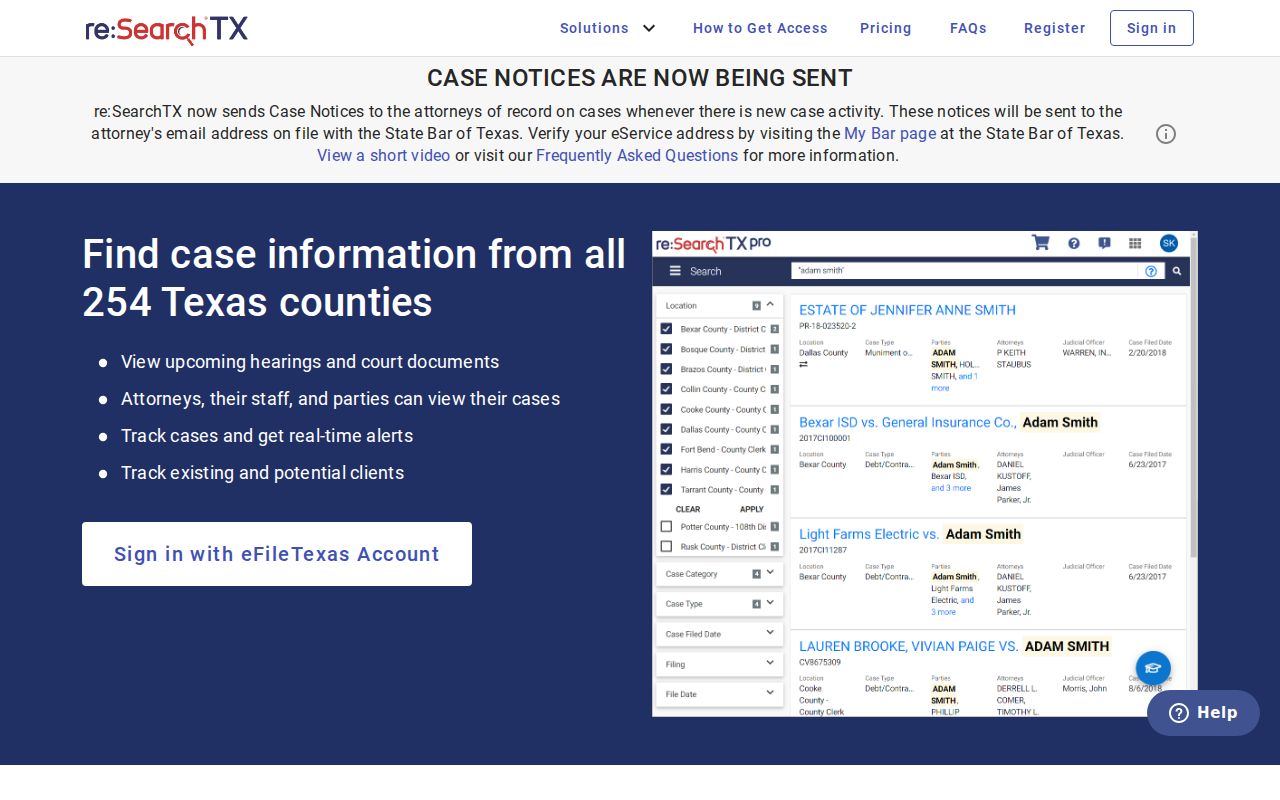
Use a result's court, case number, party role, case type, filing date, docket events, and document link as separate fields to verify. A sealed, expunged, juvenile, confidential, or unindexed matter may not appear, and a missing hit should be described only as not located in the inspected source.
| Public docket field | What it identifies |
|---|---|
| Case number | The identifier assigned by that court, not a universal personal identifier |
| Style and party role | The parties and their roles, such as plaintiff, defendant, petitioner, or respondent |
| Court and county | The court level and trial-court county where a result provides them |
| Dates and events | Filed date and public hearings, orders, filings, dispositions, or status entries |
| Document link | A public filing image where offered, subject to sealing and access limits |
Nacogdoches Vital Lookup Access
Vital records are not an open name directory. The Nacogdoches County Permitium portal accepts applications for certified birth, marriage, and death records. It identifies Texas births back to 1903, but county death service is limited to deaths within Nacogdoches County limits. Applications require eligibility, identification, and fees. A certificate application should never be treated as evidence that a record is publicly searchable.
For statewide rules, the DSHS local-office directory routes local birth, death, marriage, and divorce requests to the relevant Nacogdoches custodian. DSHS says public marriage indexes begin in 1966 and public divorce indexes begin in 1968. A certified marriage license comes from the County Clerk, while a certified divorce decree comes from the District Clerk. State verification is different from a certified local record.
Historical access follows its own clock. The DSHS request procedures state that birth records become public after 75 years and death records after 25 years under Government Code Section 552.115. Historical summary indexes can include a name, event date, county, and sex. Those facts support a dated history check, not a claim about a current address.
Nacogdoches Resident Lookup License Roles
A professional credential can be a second, date-specific identity check when the public board exposes the relevant field, but it is not a general resident list. Texas Department of Licensing and Regulation verification offers individual and business routes by industry. Its public results commonly emphasize license type, number, status, expiration, and county, while individual address and phone fields are not necessarily displayed.
The Texas State Board of Dental Examiners public search can narrow a license record by city, county, ZIP, specialty, status, date of birth, school, and other fields. Its database is updated every 24 hours. Record the exact license type, number, status, result date, and public geography before comparing it with a parcel, court, or directory result. A practice location or filing address is not proof of a private residence.
Nacogdoches Resident History Clues
For family history or an old local connection, use a dated trail instead of trying to turn historical material into current residence evidence. The East Texas Research Center city-directory collection includes Polk directories for 1960, 1984, 1985, and 1989. The ETRC also identifies Nacogdoches phone directories for 1919 and 1920. A directory can show a subscriber, household, address, spouse, or occupation exactly as printed, but its date and page need to stay with the citation.
The city's Oak Grove index adds a structured historical starting point with name, birth date, death date, section, block, and lot fields. Pair an index entry with a directory, newspaper, deed, probate file, or map before making a family connection. A burial entry does not establish city residence at death. For a broader historical shelf, the Nacogdoches Directory Book groups the dated directory collections and repository paths.
Because Nacogdoches is both a city and county seat, a place name in a record can describe city, county, rural, courthouse, or historic-jurisdiction context. Keep the jurisdiction and date in the research note.
Nacogdoches Resident Lookup Limits
Texas law limits sensitive information even when a related record is public. Government Code Chapter 552 protects some birth and death information, motor-vehicle information, and nondisclosure material. Texas voter confidentiality rules restrict phone, driver-license, state-ID, and Social Security information, and can protect or substitute certain voter addresses. My Voter Portal remains the right place for an individual's own registration check rather than a block-level list.
Lawful use. Use a Nacogdoches resident lookup for personal, lawful research, family history, estate questions, or checking an official record. Do not use public information to stalk, harass, intimidate, or harm anyone.
The Texas Address Confidentiality Program provides an eligible participant with a substitute mailing address and mail-forwarding service. A protected, sealed, redacted, or expunged record may be absent by design. The proper response is not to infer the missing information from other sources.
Nacogdoches Record Request Fallback
When the online trail ends, send a narrow request to the office that actually holds the record. Name the record type and provide a date range, address, parcel ID, instrument number, or case number. The Texas Public Information Act says a governmental body should respond promptly and, if it cannot provide the material within ten business days, give a reasonable date and explanation. The controlling statute is Government Code Chapter 552.
Use the County Clerk for recorded instruments, probate, local birth and death filing, and marriage licenses; use the District Clerk for district-court files and divorce decrees; use NCAD for appraisal corrections; and use the Elections Administrator for voter-registration administration. Older county records may instead be described in an ETRC finding aid or held on Texas State Library microfilm. Ask the custodian about inspection, copy, certification, fees, and whether the requested material is available or restricted.
Note: Keep the request focused on a specific record and date range so the custodian can identify the correct file and any applicable exception.