
Finding Nacogdoches Resident Records
There is no single roster of everyone in Nacogdoches. The most dependable starting point depends on the detail already in hand. A street address usually leads first to the Nacogdoches Central Appraisal District, where a parcel can supply an owner name, situs address, mailing address, legal description, and identifier. A full name can instead lead to a dated deed entry, a court party record, a public organization contact, or a historical directory entry. Each source records a role, not a complete biography.
Keep the source type beside each result. A parcel owner may receive tax mail elsewhere. A deed party may be an heir or representative. A directory entry is a dated snapshot, not current proof. When a record is not online, the practical route is the custodian, library, or archive that holds it. That distinction makes a Nacogdoches residents directory useful for family research, estate questions, a property-history check, or reconnecting through an official public contact.
- Search the address or name in the NCAD property search and save the property identifier, situs address, and legal description exactly as displayed.
- Use the city parcel layer to compare parcel geometry, published address fields, and ZIP data.
- Check the Nacogdoches official-record index for a recorded instrument tied to the name or legal description.
- For historical household evidence, note a directory year and page, then contact the repository that holds the volume.
- Send a focused request under the Texas Public Information Act when the needed record is request-only, naming the record type, date range, case, instrument, or parcel.
Note: A match in one Nacogdoches record is a lead, not proof that the same person currently lives at an address.
Nacogdoches Residents Directory Offices
Nacogdoches is both a city and the county seat, so local records are divided among separate custodians. The County Clerk keeps recorded instruments, probate, assumed names, marriage licenses, local vital filing, county court material, and Commissioners Court records. NCAD keeps appraisal parcel data. The Elections Administrator handles registration administration and list requests, while the Texas voter portal is designed for individual self-service. The District Clerk and local courts remain important when court access is not available through a statewide portal.
Nacogdoches County Clerk
101 W Main St, Suite 110
Nacogdoches, TX 75961
936-560-7733
Nacogdoches Central Appraisal District
216 W Hospital St
Nacogdoches, TX 75961
936-560-3447
Nacogdoches Elections Administrator
203 W Main St, Suite 113
Nacogdoches, TX 75961
936-560-7825
These offices do not perform the same job. Use the clerk for a certified recorded copy, NCAD for correction or current appraisal questions, and the elections office for registration administration. The Nacogdoches street directory keeps the fuller address-by-address chain separate from the broader directory workflow.
Nacogdoches Parcel Search Fields
The NCAD search screen is best read as an appraisal and parcel tool. Its owner search accepts a last-name-first format. The advanced screen includes street number, street name, Property ID, Geographic ID, abstract, subdivision, owner ID, tax year, neighborhood, property type, and several protest-related fields. NCAD advises users to simplify street searches and omit street type, and it notes that names can split differently, such as a spaced or unspaced surname. The help page also warns that changes take time to appear.
| NCAD field | Useful Nacogdoches purpose | Interpret carefully |
|---|---|---|
| Owner Name | Find a published tax-appraisal name | Owner of record is not automatically an occupant |
| Street Number and Street Name | Narrow a situs-address search | Follow NCAD's simplified-address guidance |
| Property ID or Geographic ID | Carry a parcel key into later checks | It is not a deed instrument number |
| Legal description and subdivision | Compare parcels in a deed chain | Older descriptions can differ after subdivision |
| Tax Year and values | Place an appraisal result in time | Appraisal value is not a sale price or proof of residence |
NCAD's help guidance is the appropriate fallback when a search returns too much or too little. The appraisal map omits some types of property, including unmapped, mineral, personal, or mobile-home property. An absent map result should not be treated as an absent person.
Nacogdoches Deed Index Trail
The County Clerk's official GovOS index has Quick Search and Advanced Search options for grantor or grantee, subdivision, document type, document number, and recorded-date ranges. It also distinguishes index-only searching from index plus full-text OCR. That difference matters: an OCR phrase search can behave differently from a party-name search. The portal displayed county certification through August 30, 2026 during research, but it did not state a complete official online start year.
A recorded instrument can connect a person to a legal role and date. It does not by itself show current residence. Start from the parcel's legal description or a confirmed owner name, record the instrument number and document type, then compare the next deed's legal description before following the trail backward. When the online record ends, the TSLAC local microfilm guide lists Nacogdoches deed material from 1835 through 1887 and index reels that reach from 1833 through 1893.
See the official-records search shown in this County Clerk index image.
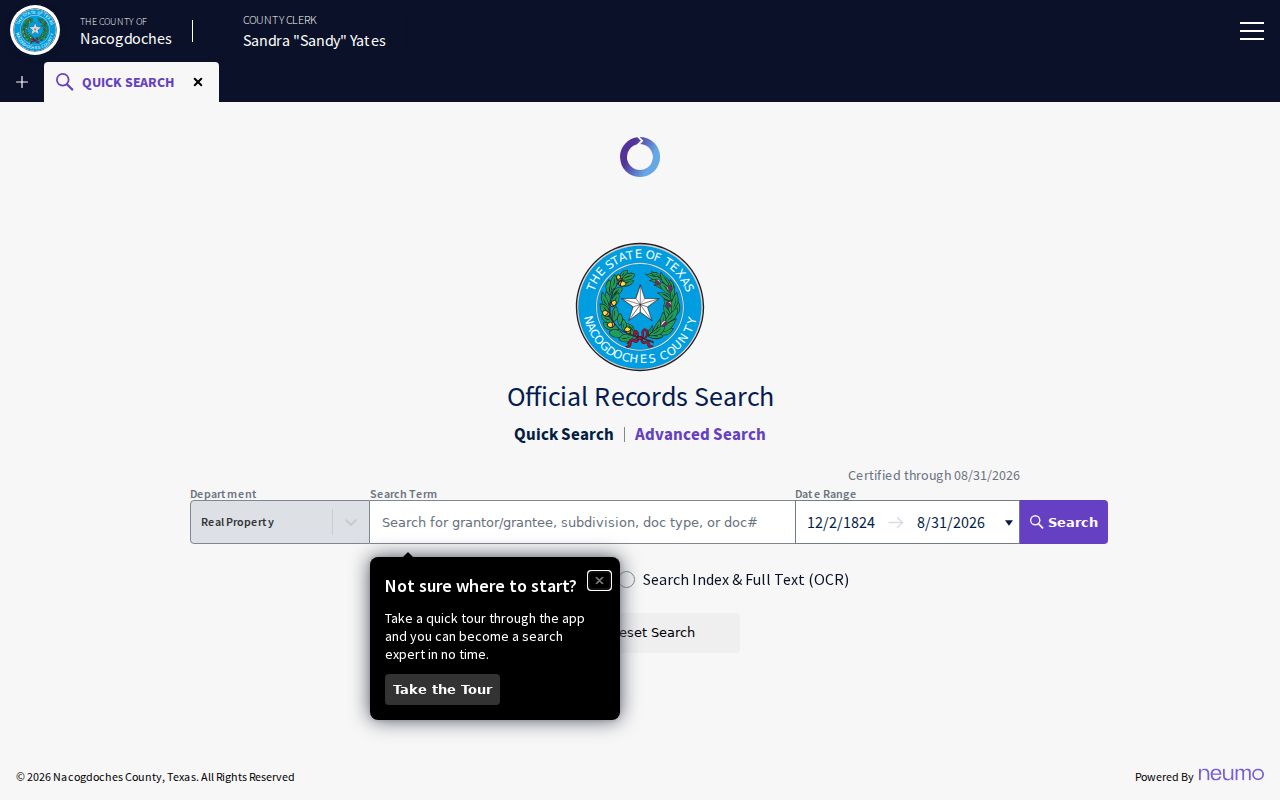
The available search modes help separate a recorded-name search from a full-text OCR query, and the clerk remains the source for certified copies.
Current Nacogdoches Resident Sources
Current Nacogdoches records describe different groups and roles. The property roll identifies a taxable parcel's published owner and address fields. The recorder identifies parties in instruments. A court file identifies parties to a case where the public record is available. The city staff directory gives public department routing. The voter system is a protected self-service and lawful-request pathway, not a street roster. Treating all of those sources as one resident list would erase their limits.
| Source | What it can show | Custodian | Access route |
|---|---|---|---|
| Appraisal parcel | Published owner/name, parcel, situs and mailing fields | NCAD | Online search and district contact |
| Recorded instrument | Grantor/grantee role, date, legal description | County Clerk | Online index; clerk copy route |
| Voter self-service | A voter's registration and polling information | Texas elections | My Voter Portal |
| City staff directory | Public city department and staff routing | City of Nacogdoches | City directory |
| Association certificate | Association filing information, not member names | Texas Real Estate Commission | Certificate search |
The most careful Nacogdoches residents directory search labels each item as an owner, party, public official, historical subscriber, or other documented role. If the goal is to verify one person across independent records, the resident lookup process uses that narrower question.
Nacogdoches Voter Records Boundaries
Texas My Voter Portal uses a name, county, date of birth, and ZIP code to help an individual check registration and polling information. It is not designed for browsing everyone on a street. A public-information request follows Texas Secretary of State forms, delivery choices, list rules, and the local Elections Administrator's process. Registration material contains fields with different access rules, including protected phone, driver-license, state-ID, Social Security, and protected-address data.
The Texas Secretary of State explains voter-address confidentiality and the limits on reproducing protected fields. Eligible participants in the Texas Address Confidentiality Program may use a substitute address. A missing or suppressed entry does not invite inference. It means the official restrictions should be respected.
Nacogdoches Address Geography
A Nacogdoches result can be city-centered, countywide, campus-related, rural, or historical. The city parcel layer keeps property-address and mailing-address field groups separate. A tax notice can go to an address that is not the physical parcel. The city ZIP layer is a postal-geography tool, not proof of city limits, voting precincts, neighborhood membership, or occupancy. That is especially important in a county seat with a university and a broader county footprint.
Nacogdoches postal routes identified in the research include 75961 through 75965. Route 75962 is associated with Stephen F. Austin State University, while 75963 is a PO Box route. Use the USPS ZIP Lookup for an address-level postal check; USPS warns that its result does not confirm a person or business. The Nacogdoches ZIP codes section keeps postal distinctions separate from a street search.
Nacogdoches History Repositories
Older names and addresses are often found in repositories rather than modern portals. The Nacogdoches Public Library is a local contact point, and the Stephen F. Austin State University East Texas Research Center holds county records, newspapers, maps, photographs, oral histories, and microfilm. TSLAC adds Spanish and Mexican-period material, county deed and marriage microfilm, city directories, and maps. The University of North Texas hosts a digitized Daily Sentinel corpus for 1900 through 1912.
The research trail reaches across unusually deep date ranges. ETRC's Nacogdoches County Records finding aid covers 1826 through 2012, while its courthouse collection reaches 1787 through 1879. A researcher should cite the exact collection, reel, volume, year, page, and record role. A historical mention may document a subscriber, an estate, a burial, a witness, or a past household. It should never be relabeled as a current resident without a current source.
The TSLAC city-directory guide explains how names, addresses, phones, spouse information, and other fields can vary by publisher and year.
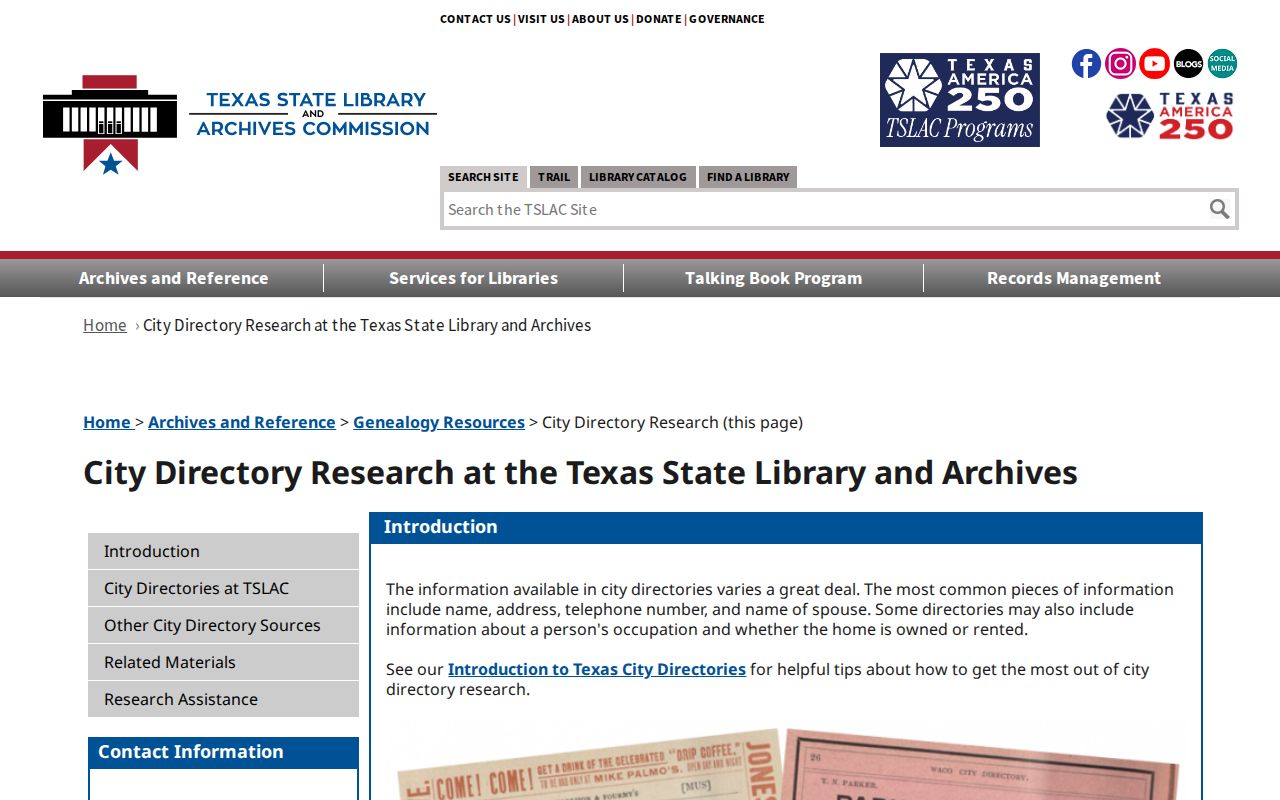
That field-by-field approach helps separate a printed address from a present-day conclusion.
Historical Nacogdoches Resident Directories
Nacogdoches historical directory evidence is spread across several collections. TSLAC lists city directories for 1960, 1962, 1984, and 1985. An ETRC finding aid identifies Polk volumes for 1960, 1984, 1985, and 1989. A local bibliography points to Brown's 1935 directory, a 1939 directory, later Polk volumes, and several telephone directories, but those entries are leads that require repository confirmation. ETRC also identifies Nacogdoches telephone directories from 1919 and 1920.
Record the entry exactly as printed, including initials, abbreviation, spouse notation, telephone number, street form, and page. Pair a directory year with a later directory, map, deed, cemetery index, probate record, or newspaper notice when names are common. The Nacogdoches directory book gives the collection-by-collection route and preserves its historical focus.
Note: A dated directory can establish a historical address or subscriber listing, but it cannot establish a present household.
Nacogdoches Cemetery and Newspaper Clues
The City of Nacogdoches maintains cemetery information for Sunset Memorial, Oak Grove, Pine Grove, and Zion Hill. The Oak Grove index uses structured fields for name, birth, death, section, block, and lot. A burial entry is useful for historical research, not evidence of current residence. It becomes more useful when checked against a directory, probate entry, or contemporaneous newspaper item.
The Daily Sentinel collection at UNT provides a digitized 1900 through 1912 corpus of 2,982 issues and 12,075 pages. Notices may show civic activities, legal notices, obituaries, marriages, and public events. Read the full item and preserve the issue date and page, since newspapers may repeat errors or refer to temporary connections.
Texas Public Information Requests
The Texas Attorney General's Public Information Act overview explains that requests go to the governmental body that keeps the record. A body should respond promptly and explain a longer production time. The controlling law is Texas Government Code Chapter 552. A focused request should identify the record type and the practical key, such as a date range, address, parcel, instrument number, or case number.
Use a request when no online index exists, not as a way to evade a privacy rule. The City Secretary handles city records routes, while county, court, appraisal, elections, archive, and library records belong with their respective custodians. Fees, copies, exceptions, and confidentiality can differ by record, so verify details with the office before relying on a result.
See the state overview of the request process in this Texas Public Information Act image.
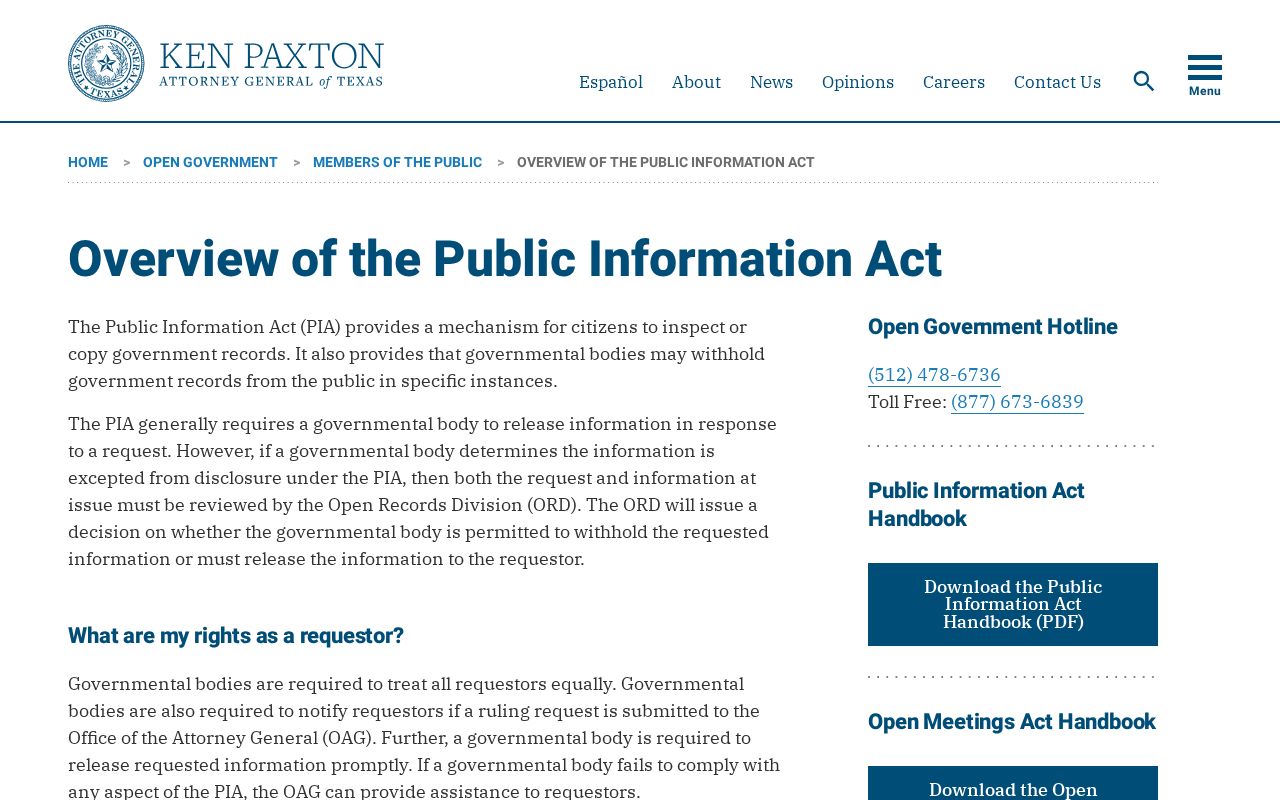
The state explanation complements, rather than replaces, the local custodian's own request instructions.
Nacogdoches Vital Record Routes
Vital records require different care from open index searching. The Nacogdoches County Permitium portal accepts certified birth, marriage, and death applications. It is not an open name index. It states that Texas birth records may be available locally back to 1903, and that county death records are limited to deaths within county limits. Eligibility, identification, and fees still apply.
Texas historical access has separate timing rules. Birth records become public after 75 years and death records after 25 years under Government Code section 552.115. A certified marriage license comes from the County Clerk and a certified divorce decree from the District Clerk, while state verification is a different product. These boundaries keep a historical fact, an application, a verification, and a certified copy from being confused.
The county portal's available record choices appear in this Nacogdoches vital-records image.
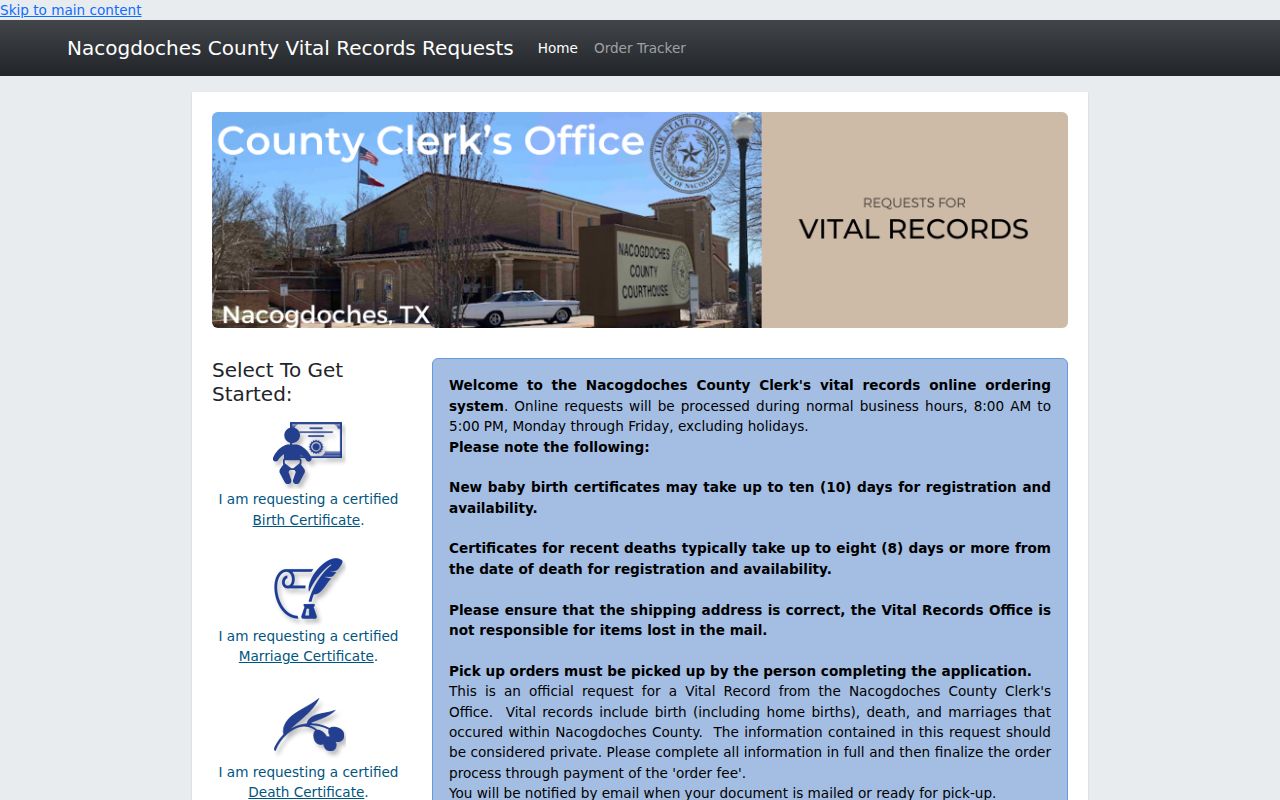
The application choices show why the County Clerk or state vital-record route is needed instead of a general resident search.
Nacogdoches Records Access Changes
Local access is still changing. An ETRC top-container record shows a County Court Records transfer dated July 31, 2025. That transfer may help a researcher locate older material through the university archive, but a transfer does not mean that every item is digitized or immediately available online. Check the finding aid and repository before planning a visit or request.
Texas court integration guidance also called for district and county clerk systems to connect with re:SearchTX by November 1, 2025. The statewide civil portal can be a useful route for cases, filings, hearings, and available documents, yet participation, document type, confidentiality, and local coverage still need live confirmation. Nacogdoches County's website transition is another reason to preserve the custodian name and official contact route when an older link changes.